Brussels believes concessions dating back to the Franco era must be renewed because Spain joined the EU for a reason. The alarms sounding in the corridors of Puertos del Estado, reported earlier this week by Puertos y Navieras, have ceased to be a mere bureaucratic hum and become a real threat to the ‘78 Regime in the Canary Islands. The infringement proceedings opened by the European Commission against Spain over the extension of concessions in the maritime-terrestrial public domain have moved from the coastline to major port infrastructure, focusing on the absurd price that the Port Authority of Las Palmas has set for the concession: an annual occupancy fee of €687,233.50 and an activity fee of 0.17% of the turnover of a business with registered assets worth €129 million and sales of €132 million.
Greek yogurt
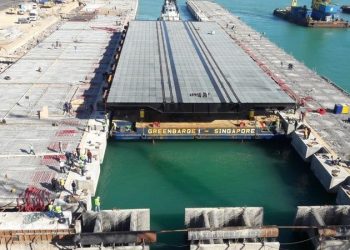
At the center of this legal clash between Madrid and Brussels is a coveted asset: the mega-extension granted to the Greek Laskaridis Group, Astilleros Canarios, S.A. (Astican), the former INI company launched during the Franco era, at the Port of Las Palmas. European Commission Executive Vice-President Stéphane Séjourné has been categorical in stating that the Spanish model directly violates EU law, the Services Directive and Article 49 of the Treaty on the Functioning of the European Union. For the European Commission, granting an extension lasting several decades is legally equivalent to awarding a new concession, which by law requires an open and transparent public tender.
Franco-era legacy
This is where Brussels’ scrutiny directly jeopardizes the future of the Greek-owned shipyard. In 2025, the Board of Directors of the Port Authority of Las Palmas approved a substantial modification that extended Astican’s original Franco-era concession by an additional 25 years. The concession dates from June 1973, six months before Carrero Blanco’s death, and its final expiry date was set for July 11, 2048.
The resolution, signed by director Francisco Trujillo, consolidated a huge area: 169,797 square meters of land and 41,342 square meters of water surface, subject to an investment plan and an occupancy fee of more than €687,000 a year. This does not include the purchase of space from Hamilton (Transcoma), which the board of Puertos de Las Palmas will approve this September on the basis of a competition report by an independent expert, not to mention the overlapping interests involving other operators that could place it in a dominant position.
Puertos de Las Palmas knows nothing
The paradox is that, while the Port Authority of Las Palmas considers this operation a legitimate tool to secure committed multimillion-euro investments without a public tender and safeguard ship repair in the islands, the European Union sees it as the perfect example of a direct award extended over 75 years without competitive bidding.
Puertos del Estado has begun requesting detailed reports from Puertos de Las Palmas on the status of these proceedings; the Port of Tenerife has not escaped that request either. If Brussels overturns the extension regime introduced by the 2014 law, the damage to the legal certainty of the Port of Las Palmas will be colossal. This is not merely a matter of reviewing licenses on the coast or at marinas; the foreign ship-repair business in Las Palmas Bay is at the exact center of the European Commission’s sights.
The article “Brussels Targets Astican’s Concession Extension at the Port of Las Palmas Until 2048” was first published on canarymaritime.com.