




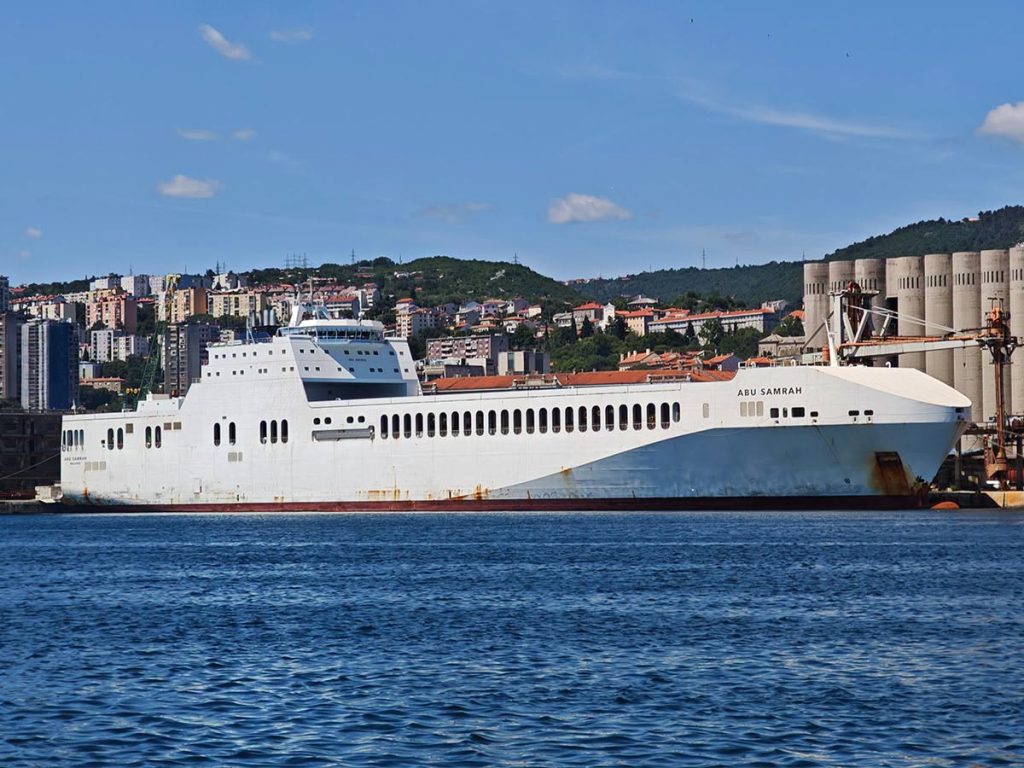
The freight transport market between the Iberian Peninsula and the Canary Islands is undergoing its deepest transformation in decades. Baleària has decided to accelerate its newly inaugurated route from the port of Cádiz through a strategy that combines an aggressive capacity expansion with a strong cultural identity message in the archipelago. The shipping company will introduce the roll-on/roll-off vessel “Josefina de la Torre” starting July 1, a giant of ro-ro cargo named in honor of the renowned intellectual from Gran Canaria, poet, novelist, lyrical singer, and actress associated with the Generation of ’27 and the avant-gardes of the first half of the 20th century.
The unit that will take center stage in the Atlantic, currently sailing under a community flag to the port of Toulon, boasts a solid track record of Central European ship engineering. The ship is the construction number 782 from the prestigious German shipyard Flensburger Schiffbau-GmbH & Co. KG, originally part of a series of nine sister ships commissioned by the Maltese firm IVP Ship Invest. Delivered in January 2023 under the name “Tennor Ocean,” the vessel was subsequently acquired by the Dutch corporation Safeen RoRo 31 Ltd. and operated on a charter in the Middle East as “Abu Samrah.” Its dimensions of 209.79 meters in length, 26 meters in width, and its gross tonnage of 32,894 tons are supported by a MAN propulsion system capable of developing 19,200 kW of power. This configuration allows it to maintain cruising speeds of 21.5 knots, a critical speed factor to ensure the freshness of agricultural products from the Canaries in the wholesale markets of the Peninsula.
The commercial maneuver of the shipping operator is not an isolated event but follows a calculated plan for identity positioning in the island market. With this decision, the company sequentially highlights the legacy of two fundamental women of the 20th century in the Canaries, adding the name of the Gran Canarian to that of the Tenerife writer Mercedes Pinto, who will name the brand new fast passenger ferry to be inaugurated on June 5. Thus, the cultural identity of the two capital islands will underpin the main strengths of the shipping company’s fleet in the Atlantic corridor.
The entry of the “Josefina de la Torre” drastically alters the economies of scale in freight transport. Its technical specifications configure the ship as the highest capacity roll-on/roll-off cargo vessel in the contemporary history of the Cádiz-Canary Islands route, thanks to its 4,070 linear meters of hold designed to simultaneously accommodate up to 279 trailers. This colossal transport capacity aims to inject certainty into the supply chains of logistics operators in the archipelago and, very significantly, to safeguard the export of the Canarian fruit sector during the peak seasonal demand periods.
The maritime sector on both shores interprets this deployment as a complete overhaul of the management model that has prevailed on the route in recent years. Baleària breaks with the continuity line of the sector and accelerates full steam ahead to distance itself from the operational deterioration and negative image accumulated by the Armas Trasmediterránea Group in the area, particularly aggravated over the last four years. To consolidate this new logistics hegemony scenario, the shipping company has structured a weekly rotation of four ships that will constantly cross between the southern Peninsula and the islands. The new flagship will be joined by the roll-on/roll-off “Villa de Tazacorte” and the mixed passenger and vehicle ferries “Volcán de Tinamar” and “Hypathia de Alejandría.”







