




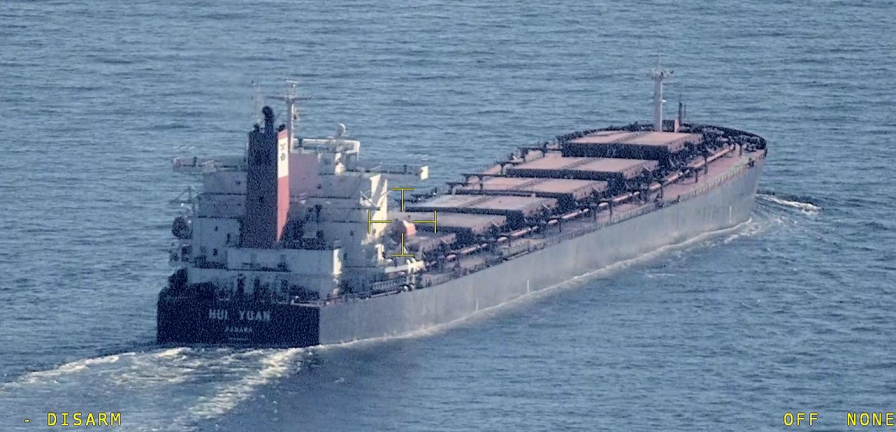
Spain is not a failed state. The Port of Las Palmas is expecting the arrival of a visitor under the scrutiny of European environmental authorities due to its interests in Russia. The bulk carrier Hui Yuan, flying the Panamanian flag, has received authorization to leave Swedish waters after reaching an agreement with the local Prosecutor’s Office regarding a coal waste discharge detected during its navigation through the Baltic Sea.
The incident, which has raised alarm among maritime security authorities in Northern Europe, occurred when a surveillance aircraft from the Swedish Coast Guard spotted the vessel while it was discharging contaminating material into the sea. This maneuver, classified as a direct violation of Swedish Environmental Code, prompted a rapid coordinated intervention. On Sunday at 08:00, the crew of the Coast Guard vessel KBV 003 intercepted the bulk carrier near Ystad, compelling it to stop.
An agreement to continue the route
The resolution of the conflict has been swift, resulting from a common legal negotiation strategy in international maritime law. The captain of the Hui Yuan has admitted the facts to investigators and has deposited a financial guarantee to cover future fines and responsibilities arising from the violation. Following this move, which secures Sweden’s sanctioning authority, the Prosecutor’s Office has lifted the exit ban, allowing the vessel to continue its journey to the Canary Islands.
Although the ship has resumed its route to the Gran Canaria port —originally coming from Russian ports— its arrival in the Atlantic does not close the case. A preliminary investigation has been opened, and the captain must appear at a hearing scheduled by Swedish authorities to determine final responsibilities for the ecological damage caused in the Baltic.
The Port of Las Palmas, a monitored node
The arrival of the Hui Yuan in the capital of Gran Canaria highlights Las Palmas’ position as a strategic point in transoceanic routes, but also the increasing scrutiny regarding compliance with environmental regulations in the shipping industry. Swedish authorities have been unequivocal about the operation: the sector must be aware of the close collaboration among European states to ensure the protection of the marine environment.
‘If we detect a suspicious ship, we intervene,’ stated Daniel Stenling, deputy director of the Operations Department of the Swedish Coast Guard, after the operation. As the Hui Yuan moves southwards, its stop in Gran Canaria will occur under the shadow of an open case for environmental crime, a reminder that sustainability standards and maritime safety are becoming increasingly stringent for vessels operating between northern ports and the Atlantic stopover in the Canary Islands.







