




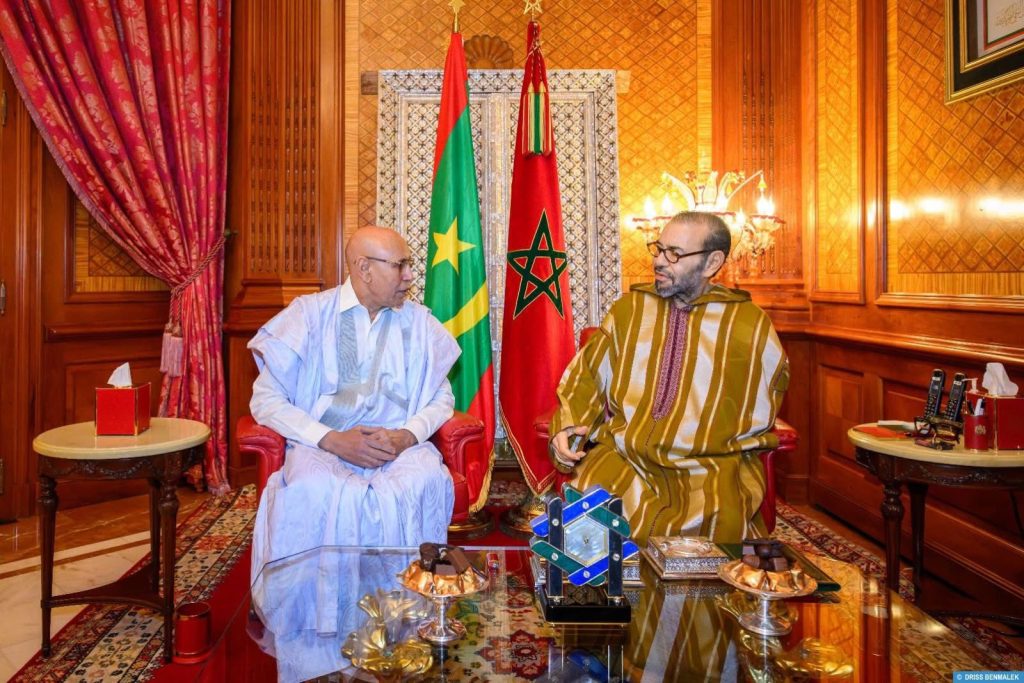
The government of Mohamed Ould Ghazouani has consolidated its role as a ‘pivot state’ in North Africa during the first week of April 2026. The reception of General Mohammed Berrid (Morocco) to coordinate border surveillance against Sahel terrorism, executed almost simultaneously with the high-level summit in Algiers with Prime Minister Mokhtar Ould Djay, demonstrates that Nouakchott prioritizes technical stability over political confrontation.
The account of these meetings highlights a subtle yet significant shift in the backdrop of the Mauritanian presidency. Although Nouakchott has recognized the SADR since 1984, the latest receptions of representatives from Polisario, such as that of Hamma Salama last February, have lacked the usual honors.
The absence of the Sahrawi flag in official photographs and the exclusion of the SADR from protocol greetings during festivities such as Aïd al-Fitr suggest that Mauritania has calibrated its communication to avoid discomforting Morocco. This ‘monitored neutrality’ follows several security incidents in which the Mauritanian army had to intercept vehicles and close border areas to prevent armed incursions from its territory toward the Moroccan defense wall.
The Mauritanian diplomatic subtlety has even reached visual language: maintaining contacts with the Polisario Front now occurs under a ‘low-profile’ protocol (without official flags), a calculated maneuver to strengthen trust with Rabat without breaking ties with Algiers. This strategy aims to secure the Atlantic trade corridor and ensure investments in infrastructure such as the Friendship Port, essential for the national economy and connectivity with the Canary Islands.
In a demonstration of diplomatic balancing, the Islamic Republic of Mauritania has engaged in intense bilateral activity this week that underscores its strategic position in the Maghreb. Between April 6 and 8, 2026, President Mohamed Ould Ghazouani has simultaneously managed the visit of Morocco’s military high command and a high-level cooperation summit with Algeria, reaffirming his policy of ‘positive neutrality’ in a region marked by Sahel instability and the Western Sahara issue.
The official visit of General Mohammed Berrid, Inspector General of the Royal Armed Forces (FAR) and number two in the Moroccan army, centered on the 6th session of the joint military commission. Over 72 hours, the delegations from Rabat and Nouakchott worked on updating their border surveillance protocols to curb the permeability exploited by terrorist groups operating near Mali.
The strengthening of this strategic alliance with Morocco encompasses critical areas such as training, operational planning, and simulations at the G5 Sahel Defense College. However, security is not the only factor: Mauritania seeks through these meetings to stabilize a relationship that is often strained by the activities of the Polisario Front in border areas, a point of friction that President Ghazouani now handles with much more measured symbolism.
Almost meticulously, while Moroccan uniforms traversed Nouakchott, a Mauritanian delegation led by Prime Minister Mokhtar Ould Djay was received in Algiers by President Abdelmadjid Tebboune. The 20th Great Joint Commission of Algeria-Mauritania has served to tighten ties in the area of classified information protection —following the agreements signed in 2025— and coordinate stances on the crisis in the Sahel and the conflict in the Middle East.
For Algeria, Mauritania is a vital partner to contain Moroccan influence on the southern flank, while for Nouakchott, Algerian support is crucial to balance regional dynamics. The most notable aspect of this diplomatic double day has been the deathly silence regarding Western Sahara in the official statements, a deliberate omission aimed at avoiding unnecessary tensions during a time of international mediation led by the UN and the United States.
Mauritania consolidates as the only interlocutor capable of bringing the two rivals of the Maghreb to parallel tables. In 2026, the stability of Nouakchott does not depend on choosing a side, but on transforming its border into a space for technical cooperation that isolates the political conflict from urgent counter-terrorism security needs.







