




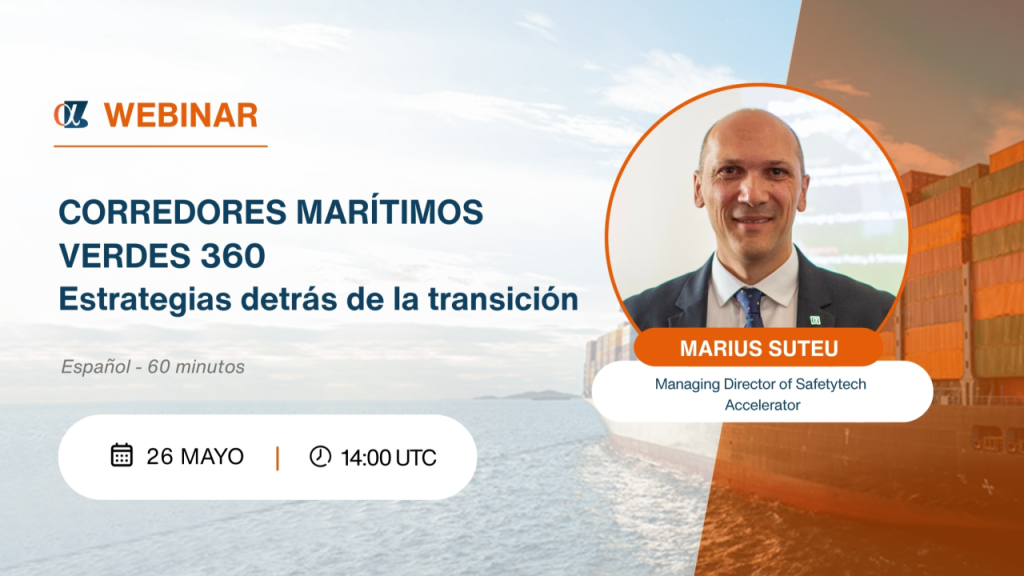
The decarbonization of maritime transport has ceased to be merely an environmental commitment and has become a critical factor in the geopolitical and economic reconfiguration of the world. The training unit of the shipping agent Alfaship, through its training division Alfaship Academy, has announced the celebration of the specialized digital meeting titled ‘Green Maritime Corridors 360’, scheduled for next Tuesday, May 26th, 2026, from 15:00 to 16:00 hours. Here you can register.
This technical forum, accessible globally via the Zoom platform through the unified institutional registration link, will prioritize addressing how new zero-emission routes are fundamentally altering investment strategies in infrastructure and the competitiveness balances at major global supply nodes, placing the Port of Las Palmas and Tenerife at the center of the regional regulatory debate.
The keynote speech at the meeting will be delivered by Marius Suteu, current Director of Emerging Opportunities at Lloyd’s Register and Technical Director at Eyesea. Suteu, who holds an Executive MBA in Senior Management and is an active member and collaborator of key sector forums such as TIC 4.0 and Energy Leap, will provide a strategic perspective backed by over 15 years of experience driving innovation and digital transformation in the maritime environment. Throughout his career, reflected in senior management positions in corporations like Navico, Aage Hempel, Lloyd’s Register, and Eyesea, he has led multidisciplinary teams and managed complex technological projects, establishing himself as an expert in product development, business strategy, and operations strictly aimed at optimizing performance and industrial sustainability.
Green maritime corridors are formally consolidating as the most decisive structural instruments for the transformation of international trade in this decade. Far from being limited to the technical deployment of new clean fuels onboard ships, these joint projects between ports, shipowners, and states are forcing an absolute redefinition of logistical routes and traditional geopolitical alliances. Suteu’s multidimensional analysis will examine the intersection between the new demands of the International Maritime Organization (IMO) and the capital allocation decisions of major transatlantic shipping companies, whose preference for ports capable of supplying alternative fuels is redrawing the call ports map in the Central Atlantic.
For the ports in the Canary Islands, a traditional distribution center for goods and the primary fuel supply station in the region, the proliferation of these green corridors poses both an immediate operational challenge and an unprecedented strategic opportunity. The technical debate promoted by Alfaship emphasizes that the locations that fail to develop infrastructure for storage and pumping of green methanol, ammonia, or bio-synthetic liquefied natural gas will face a real risk of rerouting to competing ports that are part of these clean corridors ratified by the European Union and North American powers. Thus, companies in the Gran Canaria port community are compelled to accelerate their transition plans to avoid losing competitiveness in the connectivity routes between Europe, Africa, and America.
The economic impact of these new regulations goes beyond the strictly port fabric, altering the business models of importing and exporting companies that depend on the connectivity of the islands. The seminar analysis will highlight how the cost of carbon emissions integrated into freight rates —driven by community regulations such as the FuelEU Maritime emissions trading system— will severely penalize routes that do not align with a certified green corridor. Local logistics corporations must prepare for a scenario where the sustainability of the route will be an essential contractual requirement to maintain access to the consumer markets of Northern Europe, transforming environmental investment into a strictly financial asset.
The geopolitical dimension of this regulatory change shapes a new governance framework where alliances between the public and private sectors determine the success of transportation nodes. The agenda of Alfaship Academy will explore international financing mechanisms and European Union subsidies designed to mitigate the risk of the initial phases of implementing these maritime corridors. The Canary Islands, due to its ultra-peripheral position but integrated into the European regulatory space, finds itself in a unique situation that demands close coordination between the Port Authority, energy supply multinationals, and regular container lines to secure the necessary funds for the modernization of docks and terminals.
The Alfaship training session aims to gather key players in the global supply chain, from maritime agency executives and terminal operators to trade policy analysts and corporate sustainability officers. The technical discussion on the three-dimensional scope of green corridors —covering regulatory, technological, and purely operational aspects— will provide attendees with the critical tools to anticipate changes in global cargo flows. Direct access to the seminar through the technical Zoom link provided by the academy aims to facilitate the participation of professionals from multiple time zones, reflecting global interest in a transformation that is no longer optional.
The Ministry of Transport and national regulatory bodies view these private analytical initiatives as essential components for updating national port strategies looking ahead to 2030. The speed at which the first formal agreements for creating a green corridor linking Southwestern Europe with the emerging markets of West Africa are articulated will dictate which ports will retain leadership in transshipment traffic. With this webinar, Alfaship establishes an indispensable knowledge platform for companies to adapt their business forecasts to a commercial environment where environmental compliance and logistical profitability have become identical.







