
Saturday, 17 October 2026
  • Login
  • Español
  • English
Suscribirme
Subscribe
canarymaritime.com
No Result
View All Result
  • Home
  • Atlantic Ports
    • Atlantic Africa
  • Blue Energy
  • Logistic
  • Shipbuilding Industry
    • Shipyards and Ship Repair
    • Offshore and platforms
    • Industrial innovation and naval R&D
  • Blue Economy
    • Investment and European Funds
    • Financial Sustainability
    • Private Venture Capital
  • Atlantic Geopolitics
    • West Africa
    • Port Security and Defense
    • Blue Diplomacy
    • Canary Islands as a strategic hub
    • Drug Trafficking
  • Home
  • Atlantic Ports
    • Atlantic Africa
  • Blue Energy
  • Logistic
  • Shipbuilding Industry
    • Shipyards and Ship Repair
    • Offshore and platforms
    • Industrial innovation and naval R&D
  • Blue Economy
    • Investment and European Funds
    • Financial Sustainability
    • Private Venture Capital
  • Atlantic Geopolitics
    • West Africa
    • Port Security and Defense
    • Blue Diplomacy
    • Canary Islands as a strategic hub
    • Drug Trafficking
  • Español
No Result
View All Result
canarymaritime.com
es Español en English
No Result
View All Result
Home Blue Economy & Finance Financial Sustainability

Seven Books That Transformed Navigation in the Canary Islands Between 1703 and 1915

Gara Vega H. by Gara Vega H.
17 June 2026
in Financial Sustainability
Reading Time: 3 mins read
0
44
SHARES
274
VIEWS
Compartir en WhatsappCompartir en LinkedIn
Google CONVIERTE CANARYMARITIME EN FUENTE DE NOTICIAS EN GOOGLE

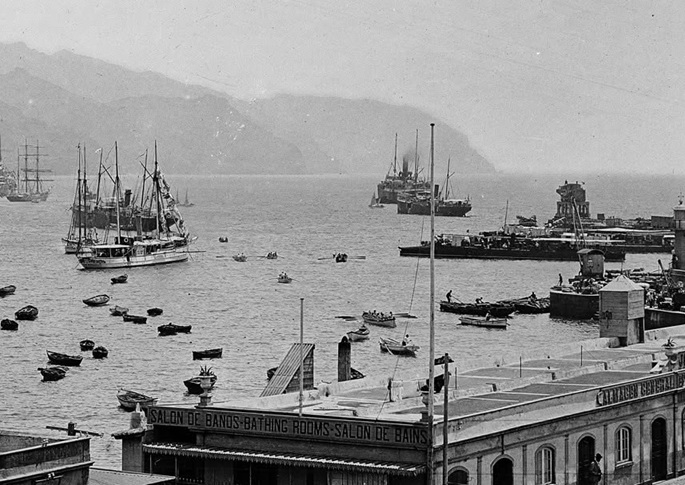
The ocean ceased to be an unfathomable abyss and became a grid of routes, assets, and discoveries where the Canary Islands were always the mandatory stop and the threshold of the known world. For three centuries, maritime literature transformed from the audacity of the solitary explorer charting the unknown to the aseptic precision of commercial manuals and bourgeois travel guides. This selection of works not only documents the advancement of navigation but also captures the precise moment when humankind stopped fearing the Atlantic to begin to own it, exploit it, and ultimately turn the archipelago into an essential destination for the European spirit.

William Dampier opens this chronicle in 1703 with A Voyage to New Holland. His account, created in 1699, narrates how his ships took on water in the Canary ports, making the archipelago the last frontier before jumping into the unknown. His pirate-turned-naturalist logbook describes navigation with a technical precision unknown for its time, laying the foundations of a science that always found in the islands a natural laboratory before crossing to the antipodes.

The 19th century radically alters the purpose of travel. William Hadfield published ‘Brazil, the River Plate, and the Falkland Islands’ in 1854. The text abandons pure geographical description and becomes an investment manual aimed at expanding the British railway network. In these accounts, the ports of the Canary Islands and their Atlantic routes appear as key logistical pieces, designed to feed London’s industrial engine with coal and products flowing through the southern Atlantic.

M. T. H. Perelaer contributes, in 1885, a disciplined perspective from the Dutch Navy with Naar den equator. The military gaze imposes a martial order over navigational routes where the islands used to be reference points for captains. Shortly thereafter, in 1894, A. E. Holt White publishes The Butterflies and Moths of Teneriffe. Victorian science folds in on itself to catalog the endemism of Tenerife. Tenerife functions here as a living laboratory; the classification of its lepidopterans reflects the era’s obsession with inventorying the biological wealth that, due to its isolation, made the Canaries a world apart.

The 20th century begins to unfold with the professionalization of the tourist. Karl Baedeker launched The Mediterranean in 1911. The bourgeois traveler accesses a carefully orchestrated map; each port has its rated stars, and the Canaries begin to stand out in guides as necessary stopover stations. Simultaneously, Florence Du Cane signs The Canary Islands in 1911. His illustrations capture the light and vegetation of an archipelago transformed into a sanatorium for the European elite, consolidating the role of the islands as the aesthetic refuge against the industrial and gray climate of northern Europe.

Harold Bindloss concludes this sequence in 1915 with Kit Musgrave’s Luck. Literature detaches from technical chronicle. In the early months of the Great War, adventure novels offer escape from continental catastrophe, often situating their plots in the seas surrounding our coasts. The sea becomes a stage where fortune and shipwreck replace commercial statistics. These seven volumes trace the evolution of our relationship with the ocean: from indomitable exploration to financial calculation, from biological classification in the Canary lands to consumer guide and literary escapism.


Google CONVIERTE CANARYMARITIME EN FUENTE DE NOTICIAS EN GOOGLE
Tags: Africa OccidentalCanariaspuerto las palmasPuertos de Tenerife
Previous Post

Who is the visible face? The secrecy surrounding the Turkish lobby of Karadeniz in its assault on the Port of Las Palmas

Next Post

What role will Fedeport adopt? The struggle for control in CEOE of Tenerife threatens to paralyze its power

Gara Vega H.

Gara Vega H.

Canarian journalist specializing in political analysis and the economy of Southern Europe. Her work is defined by a cross-cutting approach that combines institutional rigor, social sensitivity, and a deep understanding of Atlantic dynamics between Africa, the Americas, and Europe. She holds a degree in Journalism from the Complutense University of Madrid and a master’s degree in International Communication from the University of Strasbourg. She began her career in the newsroom of Axel Springer. One always returns.

NewsRelated

Lavinia lleva su batalla contra Hacienda ante el Tribunal Supremo
Financial Sustainability

Spain’s Supreme Court to rule on port concession extensions and their impact on Laskaridis’ business in Las Palmas

16 October 2026
309
Santana se proyecta hacia la lista de Ángel Víctor Torres con el PSOE por Las Palmas
Financial Sustainability

Gustavo Santana left off PSOE’s Las Palmas lists and, for now, remains at the helm of Puertos del Estado

16 October 2026
307
Puertos Canarios abre al público sus recintos para potenciar el valor del dominio público marítimo
Financial Sustainability

Puertos Canarios clarifies scope of TSJC ruling on Puerto Rico and rules out extending concessions

16 October 2026
273
Votorantim logra una prórroga de 15 años en el Puerto de Tenerife capital para ampliar su planta de Clinker
Financial Sustainability

Votorantim secures 15-year extension at Tenerife’s capital port to expand clinker plant

16 October 2026
274
Impacto en sector del congelado en Canarias: Oleada de inspecciones sobre el cartón ondulado
Financial Sustainability

Impact on the Frozen-Food Sector in the Canary Islands: Wave of Inspections Targeting Corrugated Cardboard

15 October 2026
272
Lucasiñas asume el control de Ignauro en Canarias tras la compra de la cuota de los March
Financial Sustainability

Lucasiñas takes control of Ignauro in the Canary Islands after acquiring the March family’s stake

15 October 2026
280

Leave a Reply Cancel reply

Your email address will not be published. Required fields are marked *

© 2026 canarymaritime

  • Contact
  • Transparency
  • Code of ethics
  • Legal Notice
  • Privacy Policy
  • Cookie Policy (EU)
  • Intellectual Property Rights
  • Promise to Our Readers
  • Principles on the Use of AI
  • Commitment to Our Subscribers and Advertisers
  • Español
  • English
Gestionar consentimiento

Para ofrecer las mejores experiencias, utilizamos tecnologías como las cookies para almacenar y/o acceder a la información del dispositivo. El consentimiento de estas tecnologías nos permitirá procesar datos como el comportamiento de navegación o las identificaciones únicas en este sitio. No consentir o retirar el consentimiento, puede afectar negativamente a ciertas características y funciones.

Funcional Always active
El almacenamiento o acceso técnico es estrictamente necesario para el propósito legítimo de permitir el uso de un servicio específico explícitamente solicitado por el abonado o usuario, o con el único propósito de llevar a cabo la transmisión de una comunicación a través de una red de comunicaciones electrónicas.
Preferences
The technical storage or access is necessary for the legitimate purpose of storing preferences that are not requested by the subscriber or user.
Estadísticas
El almacenamiento o acceso técnico que se utiliza exclusivamente con fines estadísticos anónimos. Sin un requerimiento, el cumplimiento voluntario por parte de tu proveedor de servicios de Internet, o los registros adicionales de un tercero, la información almacenada o recuperada sólo para este propósito no se puede utilizar para identificarte. The technical storage or access that is used exclusively for anonymous statistical purposes. Without a subpoena, voluntary compliance on the part of your Internet Service Provider, or additional records from a third party, information stored or retrieved for this purpose alone cannot usually be used to identify you.
Marketing
The technical storage or access is required to create user profiles to send advertising, or to track the user on a website or across several websites for similar marketing purposes.
  • Manage options
  • Manage services
  • Manage {vendor_count} vendors
  • Read more about these purposes
Ver preferencias
  • {title}
  • {title}
  • {title}
No Result
View All Result
  • Home
  • Atlantic Ports
    • Atlantic Africa
  • Blue Energy
  • Logistic
  • Shipbuilding Industry
    • Shipyards and Ship Repair
    • Offshore and platforms
    • Industrial innovation and naval R&D
  • Blue Economy
    • Investment and European Funds
    • Financial Sustainability
    • Private Venture Capital
  • Atlantic Geopolitics
    • West Africa
    • Port Security and Defense
    • Blue Diplomacy
    • Canary Islands as a strategic hub
    • Drug Trafficking

  • Login

© 2026 canarymaritime.com


