




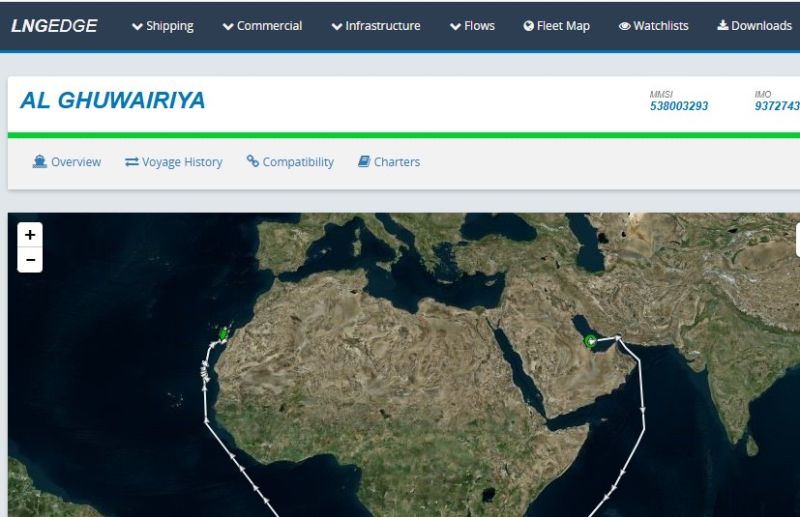
Qatar has held a strategic cargo of LNG in the Canary Islands due to the blockade of global routes. The liquefied natural gas market is increasingly fragmented by geopolitics, and the Canary Islands have emerged as an unexpected ‘waiting board’ for Doha’s strategy. This is a financial issue, not an industrial one for the Canary Islands. For now, the vessel departing from Qatar has its destination set for Las Palmas.
Canarymaritime has verified that the LNG carrier Al Ghuwairiya, one of the jewels of the Qatari fleet, has been stationed for two weeks in waters near the Canary archipelago, operating as a floating reserve while Qatar weighs its options in a European and international market marked by extreme volatility.
The Al-Ghuwairiya is an impressive liquefied natural gas (LNG) transport vessel. Built in 2008, it is one of the largest LNG carriers in the world and belongs to Qatar Gas Transport Company (Nakilat). This vessel plays a crucial role in Qatar’s LNG industry, transporting natural gas from the country’s rich reserves to clients worldwide. Its efficient design and advanced technology enable safe and reliable transportation of LNG over long distances, reinforcing Qatar’s position as a leading exporter in the global energy market.
Originally, the ship was supposed to have discharged in the United Kingdom on March 19. However, its prolonged presence off the Canary Islands underscores a ‘load optionality’ tactic. By keeping the vessel in this strategic Atlantic position, Qatar can direct supply towards British terminals, the Mediterranean, or even redirect it in response to unforeseen demand spikes, avoiding the congestion that other routes are experiencing.
The strangulation of global routes
The paralysis of the Al Ghuwairiya stands out against the activity of two other Qatari vessels that, according to market tracking data analyzed by Canarymaritime, have successfully delivered their cargoes on March 27 in the United Kingdom and Italy. Meanwhile, the LNG carrier Al Nuaman is scheduled to reach a Mediterranean port starting March 30 and may come to shepherd in the Canary Islands. These deliveries are the last remnants of a regular flow that has been severely disrupted by the conflict in the Middle East and attacks in the Red Sea.
The Gaslog Skagen vessel appears to have completed an emergency delivery to Kuwait this week. This movement reveals the vulnerability of the emirate: Kuwait is currently ‘cut off’ from massive external supply due to the closure of critical routes. The country historically depends on shipments from Qatar and Nigeria to fuel its power plants, an essential need that will become critical with the arrival of summer months and the consequent increase in air conditioning consumption.
The international market observes with keen interest the movement of the Al Ghuwairiya near the Canary Islands. It is not just a logistical matter, but an energy arbitration. In a context where normal supply routes are under fire or blocked, the Canary archipelago serves as the perfect ante-room for the European market.
The decision by Qatar to keep this cargo on hold suggests that the market has yet to find its equilibrium following the outbreak of tensions in the Middle East. While prices in the United Kingdom and Italy remain under scrutiny, the cargo of the Al Ghuwairiya represents the last piece of a puzzle where supply security takes precedence over delivery speed. The LNG sector thus enters a phase of ‘defensive navigation’ where owning the cargo is as important as knowing where and when to drop anchor.







