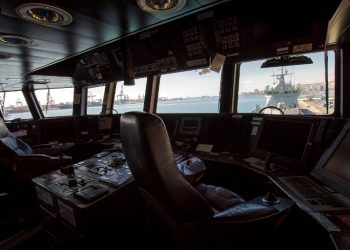
The center of gravity of European security is shifting toward the Mid-Atlantic, placing the Canary Islands’ port infrastructure at the heart of an invisible confrontation. The president of the Cabildo de Gran Canaria, Antonio Morales, has issued a formal warning in Canarias7 about the vulnerability of the Port of La Luz and Las Palmas to hybrid warfare tactics that threaten the stability of global trade. In a context shaped by the reactivation of NATO’s southern flank and the arms race in North Africa, the archipelago’s logistics and industrial business faces risks that go beyond traditional operational metrics.
The security architecture in the eastern Atlantic is undergoing rapid transformation. The combination of drone incursions in central Europe, Russia’s expansion across the Sahel and Morocco’s military buildup — backed by Section 1268 of the United States National Defense Authorization Act and a defense budget of $15.3 billion — is altering the balance along the European Union’s southern border. For Gran Canaria’s port facilities, a key hub on routes between Europe, Africa and the Americas, this dynamic brings geopolitical pressure directly to its docks, undersea cables and energy terminals.
Morales is focusing attention on the vulnerability of the port’s operational arteries to unconventional disruptions. The island’s president asserts that “in a global economy subject to growing geopolitical tensions, that position takes on a value that far exceeds port statistics; and in hybrid warfare it can be highly vulnerable.” The Island Council’s analysis maintains that the risk does not take the form of a direct military attack, but rather of a covert assault on critical infrastructure that could paralyze commercial traffic and the islands’ energy supply.
The vulnerability of the port complex in Gran Canaria is heightened by the convergence of cyberthreats, connectivity sabotage and the tactical use of migration flows in the so-called gray zone. Morales notes that “the threat taking shape is not necessarily a conventional war; it is something more complex: a permanent confrontation in the so-called gray zone, below the threshold of war, in which migration, disinformation, cyberattacks, economic pressure, espionage, territorial conflicts, infrastructure control and political manipulation are used simultaneously.” In this scenario, the accidental or deliberate disruption of fiber-optic undersea cables or the port’s fuel tanks would jeopardize shipping companies’ operations and the civilian supply chain.
The ship-repair business, bunker fuel supply and container logistics at La Luz depend on environmental stability that the Maghreb situation is calling into question. China’s growing economic presence along Africa’s Atlantic coast and Rabat’s strategic reinforcement are increasing tensions in an area where dependence on imported fossil fuels represents a structural weakness. Morales emphasizes that “hybrid warfare has one fundamental characteristic: it is difficult to distinguish between an attack and a normal event; a cable failure may be accidental, a social media campaign may appear spontaneous, a migration crisis may have entirely natural causes, and a cyberattack may come from ordinary criminals.”
As security deteriorates along Mid-Atlantic routes, the institutional response requires transforming the port’s industrial infrastructure into a shield of strategic autonomy. The deployment of offshore wind power, energy storage and stronger cybersecurity at the terminals are emerging as requirements for maintaining international investors’ confidence. Morales concludes that “the security of a territory depends not only on its soldiers or its borders; it depends on its ability to keep communications open, guarantee its energy supply, protect its infrastructure, sustain its economy and preserve its citizens’ trust.” The resilience of the Port of La Luz will determine the economic viability of the Canary Islands platform in the new geopolitical era.
The article Hybrid warfare: Antonio Morales warns of the risks to the Canary Islands’ maritime business was first published on canarymaritime.com.