




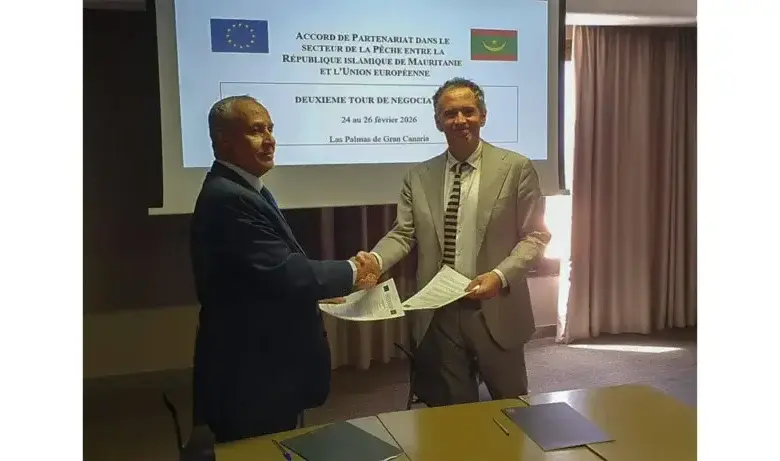
In the carpets of the AC Iberia hotel in Las Palmas, a city that serves as the unofficial embassy of Brussels in the Mid-Atlantic, the first chapter of the renewal of the most strategic fishing agreement for the European fleet in West Africa has been sealed. The delegations of the European Union and the Islamic Republic of Mauritania have concluded a round of technical negotiations that, under the signatures of Luis Moldo and Sidi Ali Sidi Boubacar, clears the administrative path before entering the real battle: the financial fee that Europe must pay to access one of the richest fishing grounds in the world.
The minutes signed in the Gran Canaria capital have focused specifically on mechanisms of monitoring, control, and transparency. For Mauritania, sovereignty over its marine resources is no longer just a matter of biomass but of infrastructure; the Mauritanian Ministry of Fisheries seeks to ensure that the exploitation of its waters benefits the development of its own ports. Meanwhile, the European delegation has prioritized the legal security of a fleet that, with the current protocol expiring next November, cannot afford a legal vacuum that leaves vessels docked at the pier.
The decision to postpone the debate on financial counterparts and catch quotas to the March rounds is not an accidental delay, but rather a maneuver of political realism. In the current context of rising operational costs and increasing fuel prices, the cost of access to Mauritanian waters will be the major hurdle. Mauritania knows it holds the leverage at a time when food security and the supply of marine protein are critical priorities for the European common market.
The timeline now points to the days of March 23 and 24, 2026, when Las Palmas will again be the stage for the second phase of updating. It will then be that technical pragmatism gives way to pure arithmetic. For the Port of La Luz, the success of these negotiations is vital: the continuity of this protocol depends on a large part of its ship repair and supply industry. The aim is to reach a new ‘transparent and responsible’ framework that ensures stability in the African fishing grounds before the November countdown reaches zero, in a game where the sustainability of the resource is the currency of exchange and regional stability is the ultimate prize.







