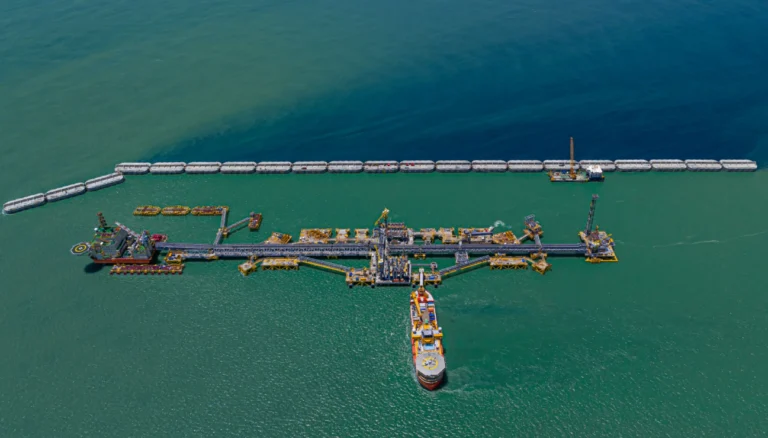
The debut of Coastal Africa Group on the AIM market in London this Wednesday has marked a milestone in the investment landscape for 2026. With a market capitalization of £218.7 million, the firm has positioned itself as the largest debut of the secondary market so far this year. Although the company, registered in the British Virgin Islands, sets its extractive sights on Nigeria and Angola, the design of its operational structure places Tenerife as the logistical and management center for its ambitions in the Gulf of Guinea.
The choice of the island is not coincidental. In the strategy of CEO Conrad Clauson, the proximity of Tenerife to the Atlantic routes linking Europe with the major shallow water fields of West Africa is a decisive competitive advantage. The integration proposed by the company — a model that combines exploration, production, and maritime logistics — finds in the port infrastructure of Tenerife the ideal support to centralize evacuation operations and fleet maintenance that will service its African assets.
In the market, the IPO has been cautious. The fundraising of £17.4 million through the sale of 10.8 million shares at 161 pence each has faced the reality of highly concentrated capital. The 93% of shares remains in private hands: the Crest Trust vehicle, linked to the Clauson family, controls 83%, while non-executive chairman Peter Kimpel and Berenberg Bank hold smaller stakes. This closed structure has kept the stock at an unusually wide bid-ask spread, with low market volume during its inaugural trading day.
The company’s operational security relies on the muscle of BP. The British oil company has subscribed to convertible bonds worth £10 million, also securing exclusivity in the marketing of crude oil and condensate extracted by Coastal Africa. This alliance is the anchor that allows the firm to project its logistical base in Tenerife. The collaboration with a partner of BP’s caliber provides the necessary solvency for the company to coordinate a complex maritime operation from the islands, reducing the execution risk in projects located thousands of kilometers away but directly connected by the Atlantic route.
The track record of Conrad Clauson, who orchestrated the sale of Coastal Energy to CEPSA for $1.7 billion in 2014, provides credibility that AIM investors especially value. Clauson aims to repeat this value cycle through an integrated approach that, according to his statements, improves operational efficiency and reduces costs in African waters. Tenerife figures in this plan as the necessary node to execute that integration, acting as a technical and command support platform that allows the company to maintain a lightweight structure in the countries where it extracts resources.
The company has set a deadline of 18 months to make its first acquisition. During this period, the firm’s ability to implement its management plans from the Tenerife hub will be closely monitored. The market seeks signs that the promised vertical integration is not just a statement of intent, but a logistical reality capable of converting barrels of crude from Angola into tangible profits in London.
For the Canary Islands business sector, the arrival of Coastal Africa strengthens Tenerife’s position as an operational base for African upstream activities. If the firm successfully executes its roadmap, the island consolidates its role as the command center for a new generation of independent oil companies. The bet is ambitious and the risk considerable; however, with BP’s financial backing and solid capitalization, the group is poised to make the central Atlantic the axis around which its growth will pivot in the coming years.