




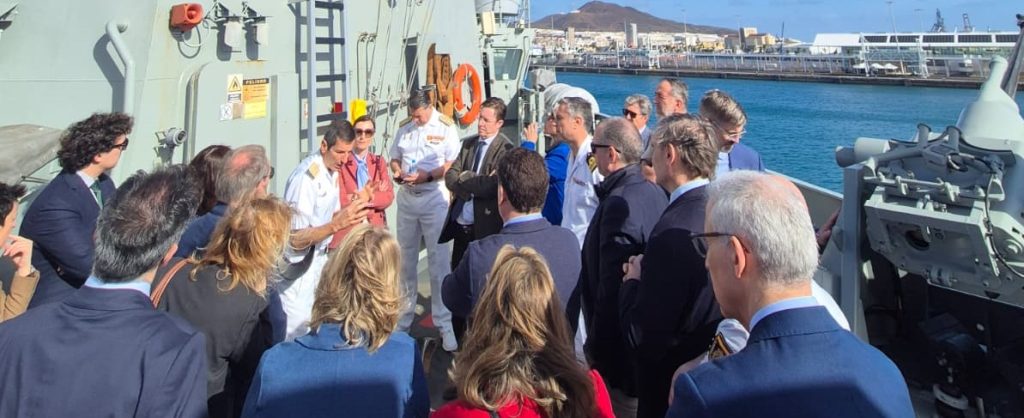
The passage of the LIV National Defense Course through the Port of Las Palmas at the beginning of February has not been a mere academic exercise, but a reaffirmation of sovereignty at the most critical moment for the Central Atlantic. Fortunately, no one would ask what a ship of the Royal Moroccan Navy has been doing in Las Palmas, the ship that is supposed to delineate the median according to Rabat’s thesis, in the Greek-owned shipyard in the capital of the island. Why was it not in a shipyard with 100% Spanish capital?
What the high commands and civil elite have observed in the islands is that Canarias is not a support platform, but the nerve center from which the Navy projects Spain’s power towards the Gulf of Guinea and the Sahel. In a global landscape where threats are no longer border-based but global, the Naval Command of Canarias stands as the necessary interlocutor for NATO, ensuring that the gray area — that diffuse border where illicit traffics and the ambitions of neighboring powers lurk — remains under Spanish control.
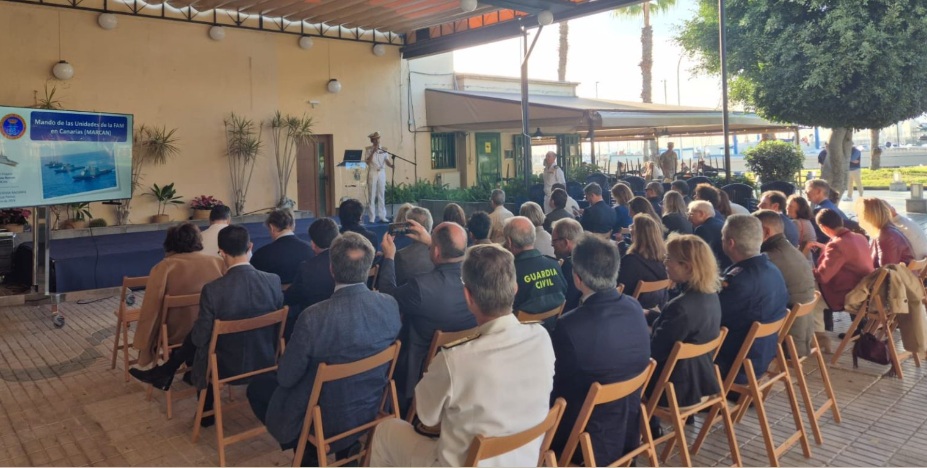
The Navy and sovereignty
The relevance of the maritime realm, highlighted during this visit to the Port of Las Palmas, goes beyond coastal surveillance. The Navy in the islands is essentially intelligence in motion. Through the Arsenal of Las Palmas and the operational capacity of its maritime action ships, the State ensures not only the protection of its waters but also the stability of the entire European defensive architecture. Ignoring the essential role of the islands in national defense would be, in the words of any state analyst, a strategic blindness that Spain cannot afford. The visit this February 2026 leaves a clear assertion: without the Navy in Canarias, the integrity of the nation would be orphaned in the ocean.
The role of the Navy in the Canary archipelago cannot be understood from a purely military perspective; it is, in fact, the piece of diplomatic and operational artillery that sustains the balance of power in the Central Atlantic. This mission, renewed in the wake of the visit of the LIV National Defense Course on February 3rd, underscores a state pedagogy: the understanding that Canarias is not a periphery, but the geostrategic center of gravity where the relevance of Spain in the world is at stake.
The Navy reaffirms that the maritime realm is the essential nerve of our security. For any seasoned observer in the offices of Brussels, the islands are the bastion of security projected over the Sahel and the Gulf of Guinea, where sovereignty is defended inch by inch against challenges ranging from migratory pressure to the surveillance of critical underwater infrastructure.
Without hesitation
The Arsenal of Las Palmas has emerged as the true logistical backbone of this strategy. We are not dealing with a static base, but with a high-tech operations center that houses the Maritime Action Ships (BAM). These units are the perfect response to modern asymmetric warfare, allowing for a prolonged presence at sea with immediate intervention capacity. In the context of 2026, with escalating tensions over the control of seabed resources and Mount Tropic, the BAM acts as the guarantor that the Exclusive Economic Zone is not just a legal abstraction, but an effectively controlled area guarded by the best naval tradition.
Beyond surveillance, the Navy in Canarias plays a fundamental role in naval diplomacy for European stability. The passage of the National Defense Course through the islands highlights that cooperative security — that training of local navies on the West African coast — is a defense in depth. The objective is pragmatic: to stabilize the neighbor to protect one’s own house. It is this overarching vision that makes the Naval Command of Canarias the indispensable interlocutor for NATO on a southern flank that can no longer afford distractions or hesitations.
The human factor and integration with the civil fabric complete a unique circle of resilience. The Navy not only provides security; it also provides intelligence and vital hydrological knowledge for the future exploitation of strategic resources. In this oceanic chessboard, closely observed from Rabat to Beijing, the Navy ensures that the archipelago remains that ‘unsinkable aircraft carrier’ that guarantees peace and commercial flow. The visit on February 3rd was not a formality, but a reminder that without the sea and without Canarias, the State defense architecture would simply collapse.
News written by Pedro Marrero. Edited and verified by José Luis Jiménez. Information cross-referenced without institutional filters. This analysis has not been funded by official advertising or conditioned by lobby interests.







