West Africa has consolidated its position as the main transshipment logistics hub for cocaine from Balkan clans destined for Europe, a situation that elevates security pressure on the Canary Islands as the closest maritime border of the European Union. Recent seizures of tons of cocaine in the Gulf of Guinea are not isolated incidents but rather a sign of a consolidated route that exploits the vulnerability of African port systems.
West Africa’s position as a transshipment point for cocaine shipments from Latin America represents an immediate geopolitical risk factor for the Canary archipelago. Reports from the Global Initiative Against Transnational Organized Crime (GI-TOC) confirm that clans from the Western Balkans, such as Kavač and Škaljari, have intensified their presence, exploiting local corruption in ports and law enforcement. This phenomenon creates a security ring south of the European Union, forcing authorities in the Canaries and the European Border and Coast Guard Agency (Frontex) to maintain constant vigilance against the potential diversion of this illicit traffic toward the island coasts.
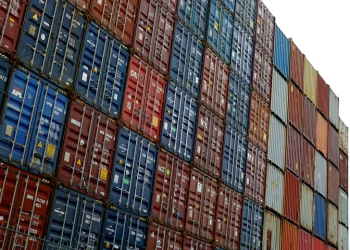
The operational method of these networks underscores the need to enhance security in the Canary ports. Cocaine arrives in West Africa by sea, where it undergoes a containerization process to conceal its true origin before being re-exported to Europe. Although most of the flow is directed to the Peninsula, the risk that drug trafficking groups may seek to use the Canary ports as a temporary storage and redistribution platform—taking advantage of the intense transshipment activity and the archipelago’s connectivity—is palpable. This threat demands a reassessment of customs risk profiles in the ports of Las Palmas and Tenerife, as well as greater collaboration with shipping companies.
The consequences of this activity transcend mere trafficking. The increase in cocaine trafficking in West Africa is generating greater corruption and violence, in addition to providing a source of funding for terrorist groups in the region. As noted by the International Observatory on Terrorism Studies, there are indications that these networks facilitate the trafficking of weapons and human trafficking, an illicit flow that has a direct impact on migratory security and regional stability, crucial areas for Spanish and European strategic interests in the Atlantic.
In light of this scenario, the strategy must be transcontinental. The GI-TOC suggests that the solution lies in forging transcontinental police alliances based on shared priorities and implementing ‘smart targeting’ strategies focused on blocking intermediaries acting as convergence points between Balkan cartels and local African actors. This need for judicial and police cooperation reinforces the role of the Canaries not only as a risk receptor but also as a potential nerve center for coordinating maritime intelligence and financial investigations on the southern flank.
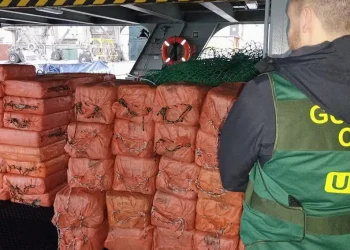
Ultimately, the success of the French Navy in the Gulf of Guinea, with the seizure of nearly 16 tons of cocaine in less than a month, demonstrates the magnitude of the problem and the effectiveness of origin surveillance. However, the phenomenon of falling prices and increased availability of cocaine in coastal West Africa indicates saturation that could increase pressure on less monitored routes. For the Canaries, the focus of security must shift from containment to anticipation, ensuring that port infrastructure does not inadvertently become a vulnerable link within the global drug trafficking logistics chain.