




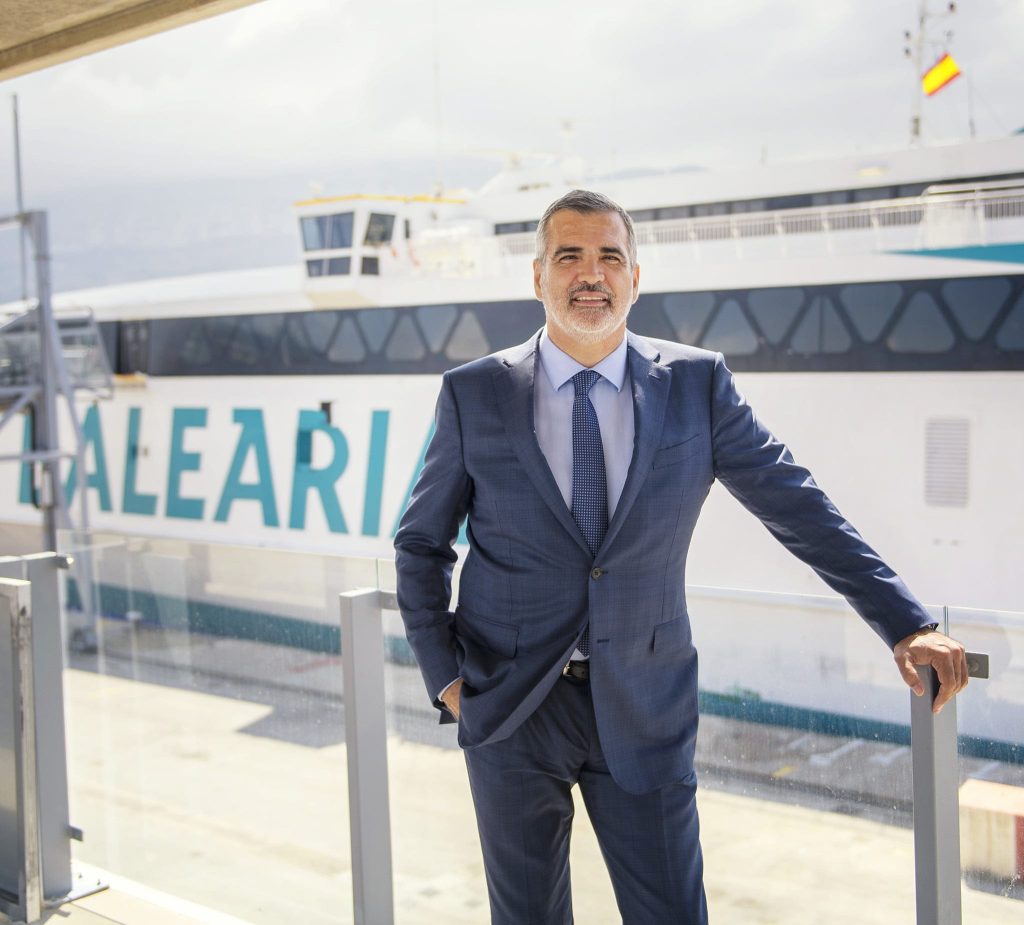
There is a form of exhaustion that only those who manage the decline of the West from the boards of directors know. Adolfo Utor, the face of Baleària, appeared in Denia with the expression of someone observing, not a balance sheet, but the autopsy of a system that devours itself in the halls of Madrid’s bureaucracy. His thesis is of a biological pessimism: Naviera Armas is dying a slow death, and every minute the CNMC spends dissecting the ‘second phase’ operation is a shovel of sand on a coffin adrift in the Atlantic.
However, in this landscape of logistical ruins, Utor’s silence on certain names is louder than his words. At the docks in the Canary Islands, it is known that the stopwatch for competition has not halted by chance.
The shadow of Vicente Boluda, the true condottiere of tugs and containers, looms over the administrative delay with the weight of a cargo ship. While the CNMC technicians, comfortable in their carpeted offices, consult manuals, the Boluda empire watches with an almost forensic interest as its rival withers. The delay is not a system inefficiency; it is, for those who understand the language of the port, a wear-down maneuver executed by someone who already controls the ground and the cranes, and is in no hurry to see the birth of a giant that could challenge the hegemony of passenger transport.
For Utor, the acquisition is not a conquest but a nearly clinical ‘rescue.’ Armas today is a specter that has sold its organs to survive: from its once-imposing fleet, only 11 ships remain. The company has abandoned vital routes such as El Hierro or Morro Jable, leaving behind the bitter trace of disinvestment. Utor warns that the ‘picture’ he is buying disintegrates at a pace that regulators are unable to process, perhaps because the whisper in the ear of the administration comes from someone who prefers that the ‘picture’ of Armas be, simply, a blank space.
The figures from the operation carry the coldness of a sentence. Baleària, which generated 801 million euros in revenue in 2025 (16% more) and obtained a net profit of 63 million, is preparing to leap into the abyss of debt. The company’s liabilities will jump from 650 to over 1,000 million euros. In this shadowy transaction, 215 million will go to bondholders, while another 60 million will be injected as pure adrenaline to avoid collapse.
In this scenario, Utor attempts to inject political realism: 30% of the new Canary Island subsidiary will be for local partners, a nameless regional aristocracy that will serve as a shield. By ceding its route in Huelva to Fred. Olsen, Baleària seeks to demonstrate that the balance is not altered. However, Utor’s tone is that of someone who knows that salvation comes hand in hand with million-dollar debt and cold calculation, while on the other shore, the owner of the tugs smiles silently, knowing that in the sea of the Canary Islands, as in life, the time your enemy loses is always your greatest net profit.







