




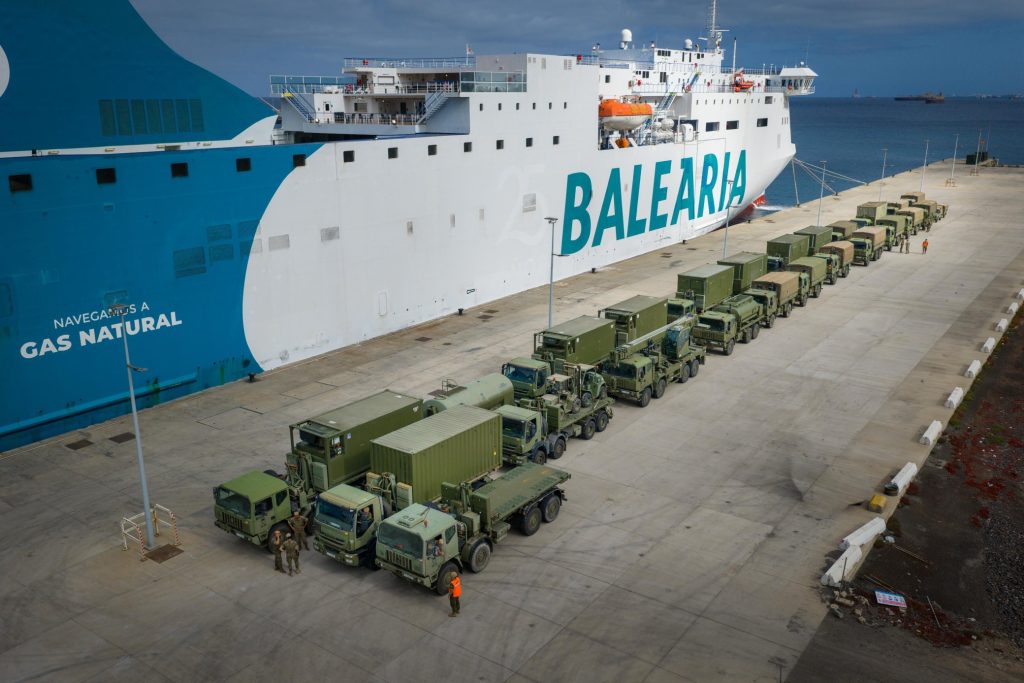
The maritime transport market in the Central Atlantic is undergoing a structural transformation with the start of the summer season of 2026. Baleària Canarias has designed a historic operational deployment through the mobilization of a fleet of 12 ships, a strategy aimed at consolidating its control over inter island routes and strengthening logistical ties with the Iberian Peninsula. The shipping company’s offensive coincides with a scenario of full operational stabilization in the archipelago, following the confirmation of total normality at the docks as the transport operations of the Mando de Canarias of the Army in collaboration with the company for the transfer of troops to the Peninsula began without having to use foreign capital port terminals. This connectivity boost is supported by the incorporation of four state-of-the-art units: the fast ferries Mercedes Pinto and Pepita Castellví, the ferry Sicilia, and the roll-on/roll-off (ro-ro) ship Josefina de la Torre.
The backbone of this summer programming begins on June 5, 2026, under the commercial name of ‘Las Tres en Línea’. This direct connection will daily link the ports of Morro Jable, Las Palmas de Gran Canaria, and Santa Cruz de Tenerife in a journey of just over four hours without the need for transshipments. The route will be operated by the new fast ship Mercedes Pinto, which will work in coordination with the fast ferries Volcán de Taidía and Volcán de Tagoro. The resulting frequency mesh will offer a potential of 6 daily departures between the two Canary capitals, 3 connections between Fuerteventura and Gran Canaria, and 2 services between Morro Jable and Tenerife, an action that raises competitive pressure on the regional logistics sector.
Conventional connectivity oriented towards heavy cargo and long-distance passengers is experiencing a parallel reactivation. The conventional ferry link between Las Palmas de Gran Canaria and Santa Cruz de Tenerife will be restored with two daily round trip services operated by the Ciudad de Ibiza ship. In the eastern islands sector, starting June 8, 2026, the ferry Sicilia will take over the line between Las Palmas and Arrecife in Lanzarote to ensure a daily round trip frequency with greater hold capacity. That same day, the daily round trip service between Gran Canaria and Puerto del Rosario will be reactivated thanks to the return of the Volcán de Tamadaba ferry to this corridor, securing the supply of goods in Fuerteventura.
The western province of the archipelago will absorb another of the major investments in maritime assets starting June 15, 2026. The new fast ferry Pepita Castellví and the Volcán de Tirajana will execute a daily triangulation between the ports of Los Cristianos (Tenerife), San Sebastián de La Gomera, and Santa Cruz de La Palma. The design of this high-speed triangle allows for the doubling of services to the Isla Bonita, reaching up to two daily departures from the south of Tenerife, while consolidating an offer of 4 daily round trip frequencies with the Gomera dock, optimizing the operating costs of the fleet in the western sector.
The external connectivity vector with the Iberian Peninsula will be drastically reinforced starting July 1, 2026. Baleària will increase the rotations between the port of Cádiz and the Canary Islands, raising the offer from 3 to 4 weekly round trips and introducing a new direct link with Tenerife. To accommodate the surge in import and export demand, the shipping company is introducing the new ro-ro Josefina de la Torre into this route, a cargo giant with a net hold capacity of 4,000 linear meters. The summer deployment is completed on the short-distance lines with the newly remodeled ferry Volcán de Tindaya, tasked with covering the strategic route between Playa Blanca (Lanzarote) and Corralejo (Fuerteventura) with 7 daily round trips, securing the economic cohesion of the archipelago.







