




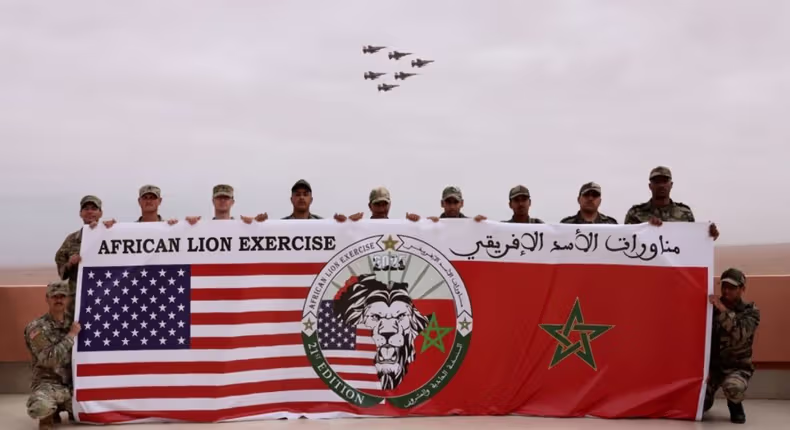
Africom has deployed its tactical architecture on the southern flank of Europe and North Africa. This year’s edition, under the direction of SETAF-AF, mobilizes over 10,000 personnel from 40 nations in a scenario that extends across Tunisia, Morocco, Ghana, and Senegal. The exercise, operational since April 20, has established Tunisia as the most advanced testing ground on the continent by integrating, for the first time on a large scale, artificial intelligence systems for predictive logistics and real-time decision-making on the ground.
Interoperability is measured in high-intensity maneuvers. Joint launches between the 173rd Airborne Brigade of the United States and Tunisian elite units define the complexity of a training that spans from multidomain warfare to the exploitation of sensitive sites for military intelligence. The technological component, supported by autonomous sensors and operational data analysis, transforms conventional operability into a rapid response ecosystem. The presence of contingents from Italy and France in these exercises reaffirms the willingness of European partners to safeguard the stability of the central Mediterranean against the instability flowing from the Sahel.
Mauritania maintains its own agenda for structural strengthening. A high-level NATO delegation, led by Colonel Gökhan Hazimli, concluded a cycle of visits to the facilities of its special forces on April 10. Meetings with Major General Mohamed Lemine Blal have focused on technical training and the improvement of tactical training for the 3rd Special Section. This approach is integrated into the ‘Defense Capacity Building’ project, a strategic movement aimed at consolidating Mauritania as a capable interlocutor to manage its border security in the face of transnational pressures.
Canary Islands observe this deployment as a necessary reflection of their own operational reality. The synchronization between the African Lion exercises and the ongoing surveillance missions in the archipelago outlines a security map where the vastness of the Atlantic ceases to be an empty space and becomes a ground of active sensors. While SETAF-AF trains for multidomain crisis response, the Canary Command maintains its physical and technological presence over the islands, ensuring that national sovereignty is not merely a declaration, but a surveillance structure that extends, silently and geometrically, from the island ravines to the African horizon. Order prevails, by sheer rigor, against the threat of ambiguity that comes from the winds of the Sahara.







