




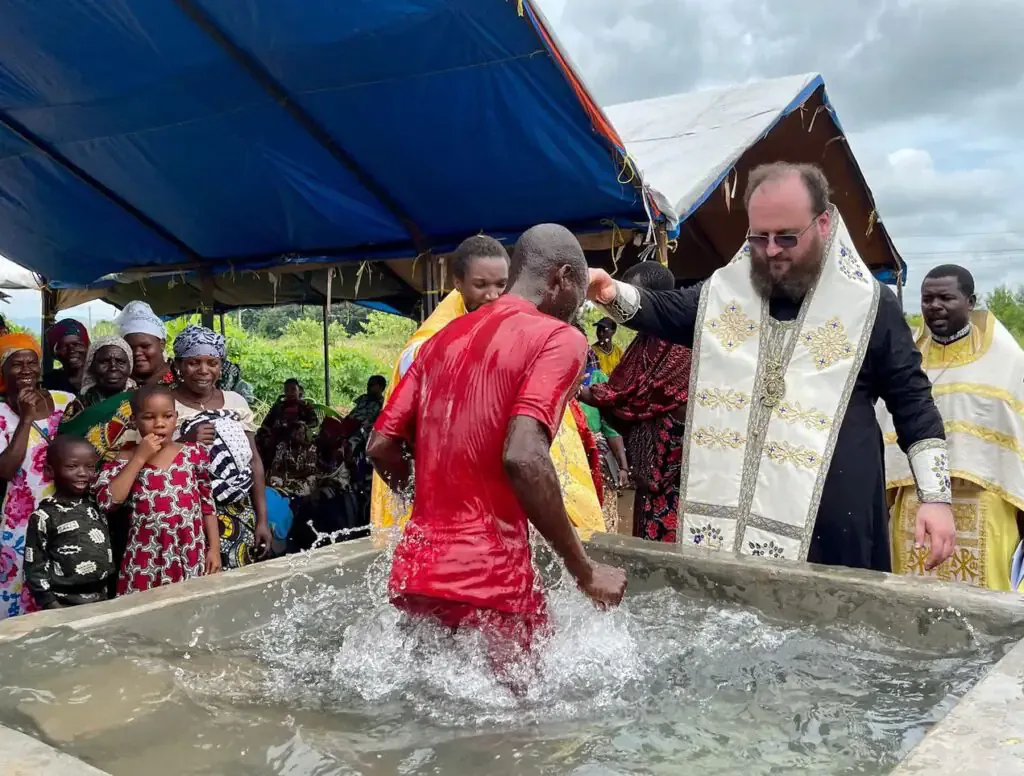
While Western sanctions suffocate its economy and its capacity for infrastructure investment pales in comparison to China’s or the U.S.’s massive loans, the Kremlin has decided to play a millennial card to keep pace on the African board: religion. In a move that the Greek clergy has already openly branded as an ‘invasion’, the Russian Orthodox Church (IOR) has expanded to 34 African countries in less than four years, becoming Vladimir Putin’s most effective ‘soft power’ tool.
The deployment is total and coordinated. Following the recent announcement of the relocation of 100 diplomats expelled from Europe to missions in Africa and the reopening of embassies such as that of Liberia, Moscow has understood that the 54 votes in the United Nations cannot be bought solely with traditional diplomacy. Lacking funds for large dams or railways, Russia now offers a ‘moral refuge’:
Russian clerics mirror Putin’s rhetoric, presenting themselves as saviors against ‘Western decadence’ and defenders of conservative family values. Moscow sells a narrative where Russia is the only ally that does not carry the colonial stigma, appealing directly to the sentiments of the world’s younger populations.
The expansion is not only spiritual. Russia has tripled its university scholarships for African students, opening language and cultural centers in strategic locations. However, beneath this facade of educational cooperation, intelligence reports and testimonies from Senegal to Kenya reveal a much darker reality.
Evidence is mounting that this soft power has a direct demographic target: labor and soldiers. The prolonged war against Ukraine has left Russian factories and the military thirsty for young people. There have been documented cases of African women recruited with promises of employment in hospitality who end up assembling drones in special economic zones, and young people lured by educational opportunities who end up, through deception, on the battlefield.
This shift towards the global south has a mandatory reading for the Canary Islands. The growing Russian influence in surrounding countries (Senegal, Mali, Burkina Faso) not only alters the security balance in the Sahel but also uses religion and culture as destabilizing tools against European interests. The Russian Orthodox Church is no longer just seeking followers; it is looking for a social support base that facilitates resource extraction and, more alarmingly, the recruitment of African citizens to fuel a war thousands of kilometers away. Moscow has stopped competing in the stock market to start competing in parishes and universities, where the capital is not the ruble, but ideology.







