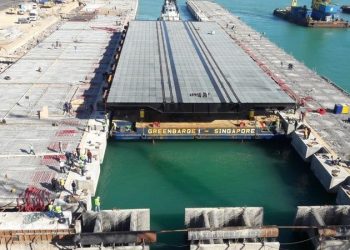
The timetable for awarding the new Casablanca shipyard has been thrown into disarray. The National Ports Agency (ANP), which was due to announce the outcome of the tender on August 5, 2026, has formally postponed its decision until December 31, 2026. The delay creates an almost five-month pause in the kingdom’s maritime strategy and provides an unexpected opportunity to reopen a fundamental debate over naval sovereignty and the role of local capital in major Atlantic infrastructure projects.
The Casablanca project has generated considerable interest among international ship-repair giants, attracted by Morocco’s strategic position at the crossroads of major global shipping routes. However, the postponement has revived criticism from technical sectors wary of dependence on foreign operators. The central question facing the industry is whether the facility should be structured as a simple concession handed over to third parties or as the cornerstone of a sovereign industrial base.
The debate is not disconnected from the recent history of Morocco’s industrial sector. For nearly seven decades, the Compagnie des Ateliers Maritimes (CAM) served as the country’s leading ship-repair company. With a workforce of more than 250 highly qualified professionals, the company operated as an integrated technical ecosystem, encompassing naval architecture, heavy fabrication, rigging and precision mechanics under international standards.
The fragility of specialized knowledge
The lessons of industrial transition suggest that naval infrastructure depends less on docks, cranes or capital investment than on the human expertise operating them. The loss of technical synergies accumulated over decades can hardly be offset by hiring global operating franchises. In marine engineering, the dispersal of skilled personnel amounts to the definitive erosion of a market’s competitive advantage.
Unlike the automotive sector, where mass assembly lines can be installed through turnkey models relying on labor-intensive workforces, ship repair is an eminently craft-based, high-precision industry. It requires shipowners’ direct trust, traceability in certification processes and the constant presence of specialists capable of resolving complex structural failures within tight deadlines.
Fierce competition along the Atlantic coast
The new Casablanca shipyard will not operate in a vacuum. The Atlantic coast features a mature market saturated with top-tier competitors. To the south, facilities such as Dakar—with the Damen group’s presence—capture a large share of African traffic. To the north, Portugal’s Lisnave and Naval Rocha shipyards add to the institutional weight of Spain’s state-owned Navantia group.
The Canary Islands are particularly representative of the North African market. Hubs such as Las Palmas and Tenerife, driven by established firms including Alimia, Zamakona and Hidramar, handle the bulk of repairs for the fishing, merchant and offshore fleets traveling along the continent’s western coast. Casablanca aims to challenge that market share, but lacking an experienced technical core from day one will make it difficult to attract customers in an aggressively competitive environment.
The mirror of industrial sovereignty
A comparative analysis of naval powers shows that states do not abandon their naval capabilities even in the face of dramatic financial losses. Spain’s decision to maintain Navantia reflects strict criteria of sovereignty, defense and innovation. In Asia, the dominance of South Korean groups such as HD Hyundai Heavy Industries and Samsung Heavy Industries is the direct result of decades of sustained public support and protection of the local supplier network.
Morocco now faces a strategic crossroads. The postponement until the end of the year gives the Ministry of Equipment and the ANP time to recalibrate the tender documents. The choice is between handing absolute operational control to an international consortium or establishing a mixed structure that guarantees the integration of former CAM employees and the retention of local technical expertise. The decision reached in December will determine whether the Port of Casablanca becomes an industrial power in its own right or is relegated to a mere logistics platform controlled by global operators.
The article Casablanca Shipyard: Another Delay Revives Industrial Debate was first published on canarymaritime.com.