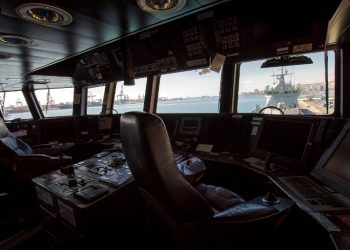
General elections scheduled for November have placed Spain’s State Security Forces and Corps and national security officials on the highest alert over the risk of a technical paralysis in the management of the Southern Flank. The government becoming a caretaker administration will activate the restrictions imposed by the Government Act, freezing its ability to approve strategic security contracts or renew essential-services tenders at the facilities in Las Palmas and Santa Cruz de Tenerife. This administrative interim period threatens to temporarily block decision-making precisely when pressure on the islands’ infrastructure is at its peak.
The analysis of the Alliance’s southern flank is no longer limited to anti-drug patrols in the Mediterranean basin or the tracking of Russian naval assets in the Strait. The attention of logistics planners and the Allied Maritime Command (MARCOM) in Northwood is focused on a decisive strategic location: the Canary Islands.
From the perspective of hybrid warfare, the Canary Islands constitute the nerve center of the resilience of the fiber-optic cable network connecting Europe, Africa and the Americas. They also serve as the logistical and intelligence hub in response to the deterioration of political and military stability across the Sahel. The legal inability of a caretaker government to sign new defense-diplomacy agreements or formalize bilateral agreements on port cooperation and maritime surveillance with source and transit countries such as Mauritania and Senegal temporarily freezes key initiatives aimed at containing threats from the Southern Flank.
In a geopolitical environment shaped by the reconfiguration of global routes following the attacks in the Red Sea and by persistent instability in the Sahel and along the West African coast, the central Atlantic’s capacity to absorb military and civilian traffic has become a top priority.
Logistical muscle and supply-chain resilience
The ports of Las Palmas and Santa Cruz de Tenerife are not merely commercial transshipment facilities; they are key nodes for operational resilience and force projection. With an estimated intermediation centrality of 0.217 within the regional system and the capacity to manage the fishing cold chain and strategic supplies, Gran Canaria acts as the logistical lung stabilizing the maritime corridor between Europe and the Gulf of Guinea.
The concentration of Mauritanian trade—84.2% across just three container routes—and the vulnerability of the Nouakchott node reveal a level of structural rigidity that NATO is closely monitoring. A major disruption to receiving infrastructure in Africa would immediately shift operational pressure onto Spain’s island facilities.
Bunkering and the reconfiguration of maritime routes
For Allied forces operating on deterrence and freedom-of-navigation missions in the central Atlantic, the guarantee of rapid resupply with VLSFO and distillates in a territory covered by the collective security provisions of Article 5 of the North Atlantic Treaty represents an indisputable advantage over the recurring supply shortages recorded at continental ports in the region, such as Luanda and Lagos.
The hybrid threat and critical infrastructure
The Alliance’s focus in the central Atlantic also extends to the protection of undersea critical infrastructure. The fiber-optic cables linking Europe, Africa and the Americas form a network in which water security, connectivity and maritime stability are inseparable. Strengthening response capacity, traceability in maritime trade and port infrastructure in the Canary Islands is seen not only as a regional or autonomous-community policy priority, but also as a structural element of the central Atlantic’s security architecture.
The article Canary Islands ports placed on highest alert ahead of general election was first published on canarymaritime.com.