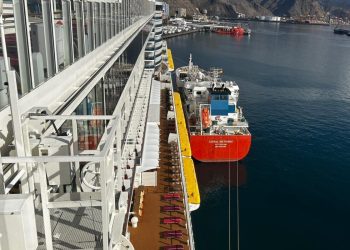
In the Atlantic maritime sector, sustainability has ceased to be a public-relations metric and become a factor in operating costs and regulatory compliance. As traffic at the Port of La Luz adapts to the growing environmental restrictions imposed by the European Union and the International Maritime Organization (IMO), ship-waste treatment engineering is consolidating its position as one of the segments with the greatest potential profitability in the port-services chain.
The recent award presented to Transvirgin at the 2026 Canagua and Energy Awards —promoted by the Gran Canaria Island Council through its island councils for Water and Energy— highlights a silent but structural transition on the docks of the island’s capital: the conversion of slops and marine effluent collection into a hub for producing regenerated industrial water.
The chemistry of opportunity under the MARPOL Convention
Founded in 2006 under the leadership of Manuel Galindo, Transvirgin entered the Gran Canaria harbor as the first concession holder authorized to provide the port service for receiving liquid waste regulated under the International MARPOL 73/78 Convention. What for decades had been a logistics activity involving hauling and subsequent controlled disposal through authorized waste managers has shifted toward a process that is capital-intensive and technology-driven.
Advanced treatment of complex effluents: The plant operated by the company in the port area processes highly contaminated effluents —mixtures of hydrocarbons, gray water and liquid waste in the MARPOL Annex IV category— using physicochemical processes, biological separation and reverse-osmosis filtration.
Closing the water cycle within the port complex: The operational result turns an environmental liability into high-purity industrial water. This offering reduces the port’s water footprint by providing shipyards, shipping agents and vessels undergoing repairs with a supply alternative that does not overload the island’s potable-water networks or depend on traditional desalination, which has a high electricity demand.
Technical strength over corporate rhetoric
The recognition for business initiative presented at CANAGUA contrasts with the usual dynamics of sustainability subsidies in the archipelago. Unlike public programs focused on preparing intangible-asset reports or sector seminars, Transvirgin’s model directly monetizes the regulatory requirements faced by international shipping companies when they call at Las Palmas.
The article Marine Waste: Canagua Honors Transvirgin at the Port of Las Palmas on Its 20th Anniversary was first published on canarymaritime.com.